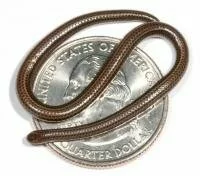
 The world's smallest species of snake, with adults averaging just under four inches in length, are to be found in Barbados. The species -- which is as thin as a spaghetti noodle and small enough to rest comfortably on a U.S. quarter.
The Caribbean is particularly vulnerable because it contains an unusually high percentage of endangered species and, because these animals live on islands, they have nowhere to go when they lose their habitat as the islands become more and more developed.
The Barbados species known to its locals as "the Seven days snake" is new to science on the basis of its genetic differences from other snake species and its unique color pattern and scales.
Scientists use adults to compare sizes among animals because the sizes of adults do not vary as much as the sizes of juveniles and because juveniles can be harder to find. In addition, scientists seek to measure both males and females of a species to determine its average size. It is determined that this species, is the smallest of the more than 3,100 known snake species.
In contrast to larger species -- some of which can lay up to 100 eggs in a single clutch -- the smallest snakes, and the smallest of other types of animals, usually lay only one egg or give birth to one offspring. Furthermore, the smallest animals have young that are proportionately enormous relative to the adults. For example, the hatchlings of the smallest snakes are one-half the length of an adult, whereas the hatchlings of the largest snakes are only one-tenth the length of an adult. The Barbados snake is no exception to this pattern. It produces a single slender egg that occupies a significant portion of the mother's body.